The Wall Before the City: How Mohenjo-daro's Layers Are Rewriting Urban Origins
New excavations at Mohenjo-daro are raising questions about when its massive wall was built and what it reveals about how cities actually grow—not as sudden blueprints, but as gradual experiments.
Kavya Sharma for SwavedaMay 7, 2026
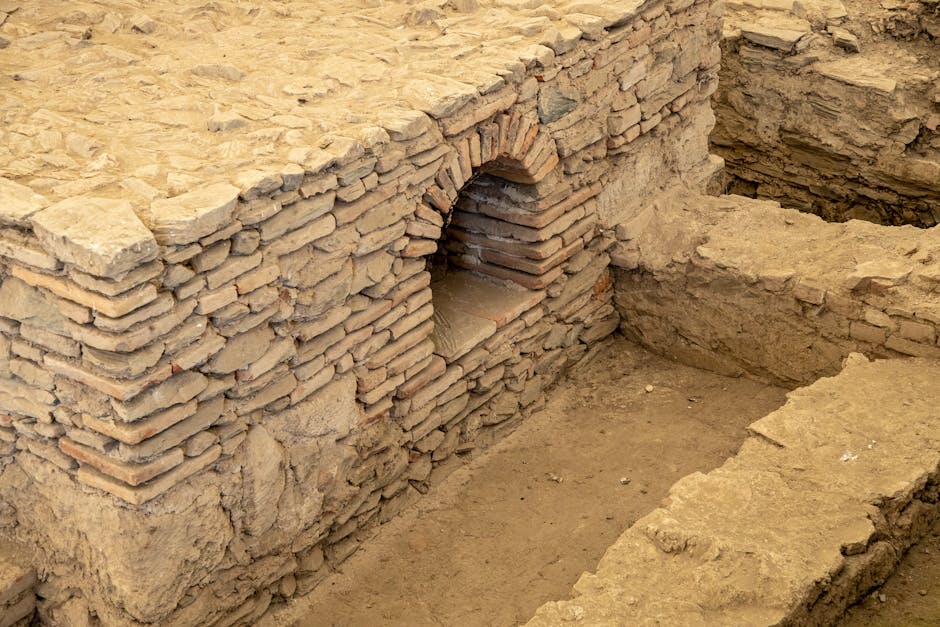
For a century, archaeologists believed Mohenjo-daro burst into existence around 2600 BCE—a finished urban masterpiece, complete with brick drains and grid-planned streets. The emerging picture from recent excavations suggests something messier and more human happened instead: a settlement that grew, hesitated, built walls, and only later became the planned city we recognize.
The story begins with a structure that has puzzled diggers for decades. In 1950, Sir Mortimer Wheeler, one of archaeology's towering figures, excavated a massive mud-brick perimeter wall west of Mohenjo-daro's famous Stupa Mound (a ceremonial dome-shaped structure). Wheeler interpreted it as a revetment (a facing wall meant to stabilize an embankment) or flood protection. But its true purpose and age remained uncertain for three-quarters of a century.
That ambiguity is now under scrutiny. Between 2015 and 2020, excavations resumed at the site under a joint mission led by Pakistani and international archaeologists. The team has recovered pottery and radiocarbon samples from layers both beneath and within the wall structure—evidence that could help date when it was built and what stood before it.
Here is what the evidence currently shows: pottery consistent with the Early Harappan period (sometimes called the Kot Diji phase, after a pottery style recognizable by its decoration and shape) appears in layers beneath the wall. This indicates a settlement existed at the site before the wall rose. The wall itself, scholars argue, likely dates to somewhere within the transition between the Early Harappan and the Mature Harappan periods—a window spanning several centuries around 2800 to 2600 BCE. Exact radiocarbon dates from the recent excavations have not yet appeared in peer-reviewed journals or published excavation reports accessible to the broader archaeological community. The work is recent, and publication takes time.
The traditional narrative treats Mohenjo-daro as part of a sudden urban flowering around 2600 BCE. The Harappan Civilization (also called the Indus Valley Civilization) is often presented as a finished system: planned grids, standardized bricks, drainage, warehouses, seals. The appearance is sudden enough that early scholars wondered whether it had been imposed by invaders or migrants. More recent work has emphasized continuity with earlier settlers, but the moment of "urbanization" remained largely fixed at 2600 BCE.
This emerging evidence suggests the story is slower and less tidy. People lived here. They made pots in recognizable styles. Then, over generations, they decided to build a wall—not overnight, but across phases of construction and rebuilding. The wall was expanded, reinforced, and maintained across centuries.
What was the wall for? Tradition holds that Harappan cities were largely non-militaristic; unlike cities in Mesopotamia, they show little evidence of war-making or fortification. Yet this wall was seven meters thick and substantial enough to require years of labor. Scholars debate whether it was primarily defensive, hydraulic (managing flood or drainage), administrative (controlling movement and trade), or some combination. The answer may lie in features not yet excavated. Future seasons aim to locate gateways—the openings where goods and people moved through. Gateways tell stories. They show where trade flowed, how labor was organized, whether access was restricted.
The archaeology of walls is the archaeology of how people organize themselves: how they decide what is inside and outside, who belongs, how movement happens. A wall says this is ours. It says here is how we do things. It rarely says why all at once.
What makes this excavation significant is not the wall itself but what it reveals about how urban life actually begins. We tend to think of cities as born from a vision—a plan, a founder, a moment. But Mohenjo-daro's layers suggest something different: experimentation. Living requires rooms. Rooms require boundaries. Once boundaries are drawn, they suggest other boundaries. Infrastructure follows. Standards emerge. A grid takes shape. Not because someone drew a blueprint and declared build this. Because the work of daily life—storing grain, moving water, gathering for trade—leaves traces, and traces suggest order.
The challenge now is verification. The radiocarbon dates and pottery identifications from recent excavations remain in the process of peer review and publication. Until those findings appear in accessible scholarly journals, archaeologists working elsewhere cannot yet fully test, replicate, or build upon them. This is how archaeology works: a finding in the ground is only half the story. The other half is the scholarly conversation that follows—the checking, the questioning, the integration with what we know from other sites.
The wall stands—literally, in the ground at Mohenjo-daro, seven meters of mud brick—as a question. Not yet fully answered, but asked more clearly than before. And that, in archaeology, is often where the real story begins.