The Ghost of Khariboli: How a Delhi Market Dialect Became an Empire's Two Languages
A Delhi marketplace dialect split into Hindi and Urdu not by accident, but by deliberate choices of empire and politics. Etymology reveals how power reshapes language, one vowel at a time.
Asha Naidu for SwavedaMay 7, 2026
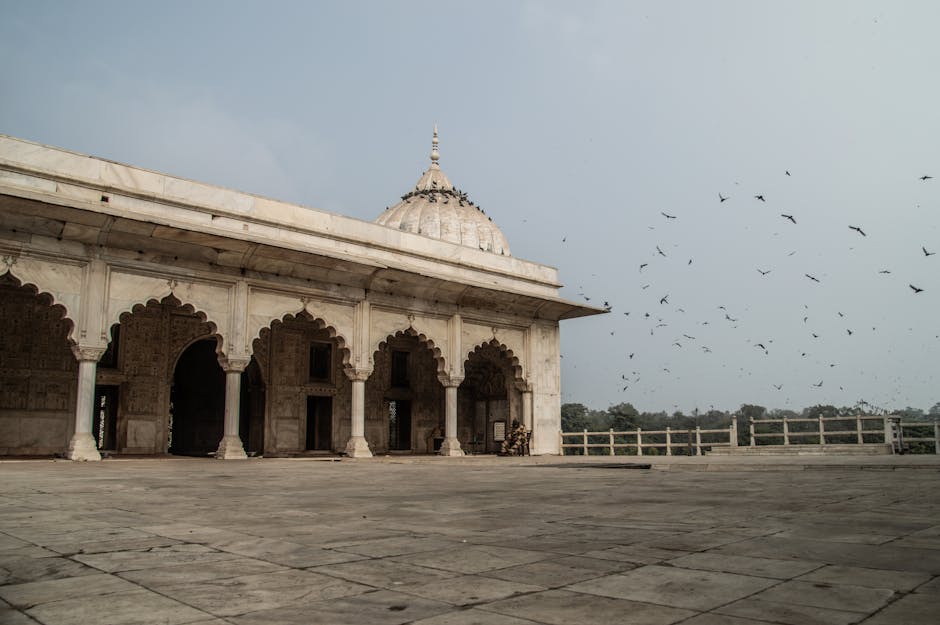
Walk through the narrow lanes of Old Delhi—past the Jama Masjid, through the spice bazaars—and you hear a language that sounds like neither crisp formal Hindi nor the elaborate Urdu of Mughal poetry. It's a straightforward, sometimes rough dialect called Khariboli, the "standing dialect." The name itself harbors a debate. To its critics, khari meant stiff, rustic—the uncouth speech of traders and soldiers. To its speakers, those who dismissed other dialects as pariboli (dialects perceived as less prestigious) were simply dismissing what they did not understand. What neither side fully grasped was that this unpretentious market language would eventually become two rival national languages, each claiming to represent the true soul of northern India.
The story of how Khariboli split into Hindi and Urdu is not simply a tale of linguistic drift. It is a story of empire, power, and the way political authority reaches into grammar itself, reshaping how people speak—and ultimately, how they imagine themselves as communities.
A Dialect Before an Empire
Khariboli originated in Delhi and the surrounding Ganges-Yamuna Doab (interfluve—the land between two rivers). During the Mughal period, when political power became centered on Delhi, Khariboli absorbed numerous Persian words and came to be used as a lingua franca (a common language used across different groups).
Khariboli was adopted by Afghans, Persians, and Turks as a common language of interaction with the local population. This is crucial: the language was not imposed top-down from courts. Instead, it emerged organically as soldiers, merchants, and administrators needed to communicate across ethnic and linguistic boundaries. The area around Delhi had long been the center of power in northern India, and naturally, the Khari Boli dialect came to be regarded as urbane and of a higher standard than surrounding languages.
Before the 19th century, however, other languages such as Awadhi, Braj Bhasha, and Sadh Bhasha (refined speech of wandering ascetics) held greater prestige in literary circles. Braj Bhasha, in particular, remained the dominant literary language written in Devanagari script well into the 1800s, before advocates of Hindi began deliberately promoting the Delhi dialect as the standard form.
The Mughal Court and the Birth of "Hindavi"
The medieval poet and scholar Amir Khusro, who lived during the Delhi Sultanate period (13th-14th centuries), used these forms in his writings and referred to them as Hindavi (meaning "of Hindus" or "of India"). What emerges from the evidence is that Hindustani—and later, Urdu and Hindi—was never a "pure" language. Hindustani retained the grammar and core Indo-Aryan vocabulary of Khariboli, but as an emerging common dialect, it absorbed large numbers of Persian, Arabic, and Turkic loanwords. As Mughal power expanded, Hindustani spread as a lingua franca across much of northern India—a direct result of sustained contact between Hindu and Muslim cultures that scholars call the Ganga-Jamuni tehzeeb (a composite syncretic culture blending both traditions).
This hybridization created compounds where neither parent language could claim ownership. Take rajmahal (palace): raja means "royal" or "king" in the Indian substrate, while mahal means "house" or "place" in Persian. Or rangmahal (fashion house): rang means "colour" or "dye," paired with mahal. These were not awkward borrowings—they belonged wholly to neither parent language. They belonged to a new vernacular being born in the spaces between empire and marketplace.
The Court's Choice: Naming Urdu
The Delhi Sultanate established Persian as its official language, a policy the Mughal Empire continued and reinforced. But something shifted in the late Mughal period. According to scholars interpreting Khan-i Arzu's 18th-century linguistic treatise Navadirul Alfaz (Rare Words), a language called "Zaban-e Urdu-e Shahi" (language of the imperial camp) had attained special importance during the reign of Aurangzeb (r. 1658–1707). The precise dating and scope of this shift remains contested among scholars, but by the early 1700s, the common language around Delhi began to be called Zaban-e-Urdu, derived from the Turkic word ordu (army or camp).
The naming of Urdu was not random. The term became standardized in literary usage by poets such as Ghulam Hamadani Mushafi, who wrote in the late 18th century. By that time, the language had already absorbed centuries of Persian influence. While Urdu retained the grammar and core vocabulary of Khariboli, it adopted the Perso-Arabic writing system, written in the Nastaleeq style (an ornate Persian script).
The Nineteenth-Century Split: When Politics Rewrote Grammar
For centuries, what we now call Hindi and Urdu were not competitors. A Persianized variant of Hindustani had taken shape during the Delhi Sultanate and Mughal Empire across South Asia, known as Deccani in the south and by names such as Hindi, Hindavi, and Hindustani in the north. It was written in multiple scripts: Devanagari, Perso-Arabic, Kaithi, and Gurmukhi.
The rupture came during British rule. Hindi as a standardized literary register arose in the 19th century, actively promoted by Hindi advocates beginning around the 1880s, as scholars including Francesca Orsini and Sheldon Pollock have documented. The goal was explicit: to incorporate Hindi into administration and education, where Urdu had held a linguistic monopoly.
This was not a natural splitting. It was a political choice, written in vocabulary. Hindi and Urdu continued to diverge linguistically and culturally. Hindi drew increasingly from Sanskrit; Urdu from Persian, Arabic, and Chagatai Turkic. Culturally, Urdu became identified with Muslims and Hindi with Hindus.
Yet scholars note that the two remain fundamentally the same—though they debate the precise degree of mutual intelligibility today and disagree on the exact periodization of their divergence. As linguist Sekhar Bandyopadhyay observed in The Social Life of Language (2008), Hindi and Urdu were "the same language written in two scripts; Hindi was written in Devanagari script and therefore had a greater sprinkling of Sanskrit words, while Urdu was written in Persian script and thus had more Persian and Arabic words in it."
Etymology as History
Every word in Hindi and Urdu carries this inheritance. The root bol (to speak) appears as far back as 2nd-century Shauraseni Prakrit, with cognates in Marathi, Punjabi, and Bengali. It is ancient, Indo-Aryan, native. But context shifted: boli in Hindi denoted a living dialect; zabaan in Urdu—Persian for "tongue"—lent it courtly distance.
Or take ordu itself. The Chagatai Turkic word meaning army is also the etymological ancestor of the English word "horde." The term was first applied to the language during the late Mughal era. A word born from military camps, standardized into a literary register, then nationalized as a symbol of one community's identity. In that transformation lies the entire history of postcolonial India and Pakistan.
The Living Ghost
Khariboli persists today, mostly unwritten, in the speech of traders, families, and ordinary people in Delhi and western Uttar Pradesh. It is not dead—it is a ghost that haunts both Hindi and Urdu, visible in their grammar and basic vocabulary, but erased from official standards.
The split into Hindi and Urdu was never about language. It was about power: which script would dominate, which vocabulary would be official, whose god would speak. But underneath both, Khariboli lives on—a reminder that empires remake languages from within, one vowel shift, one borrowed word, one deliberate choice at a time.