Agroha, the town that called itself Agrodaka
Fifty-one silver coins from a 1938-39 ASI dig in the Hisar plain proved the Aggarwal community's traditional homeland was a real second-century-BCE town — though not the prehistoric kingdom legend describes.
SwavedaApril 29, 2026
Roughly 22 kilometres north-west of Hisar, on the road to Fatehabad, a series of low mounds rises out of the dry Haryana plain. The highest is about 87 feet above the surrounding ground. The whole complex of mounds covers roughly 650 acres, immediately to the north-west of a village that calls itself Agroha. Local tradition holds that a king named Agra, later called Agra Sain, lived here, and that the remains on the highest mound mark his fort.
What the archaeology shows is more specific, and in a way more interesting, than the legend.
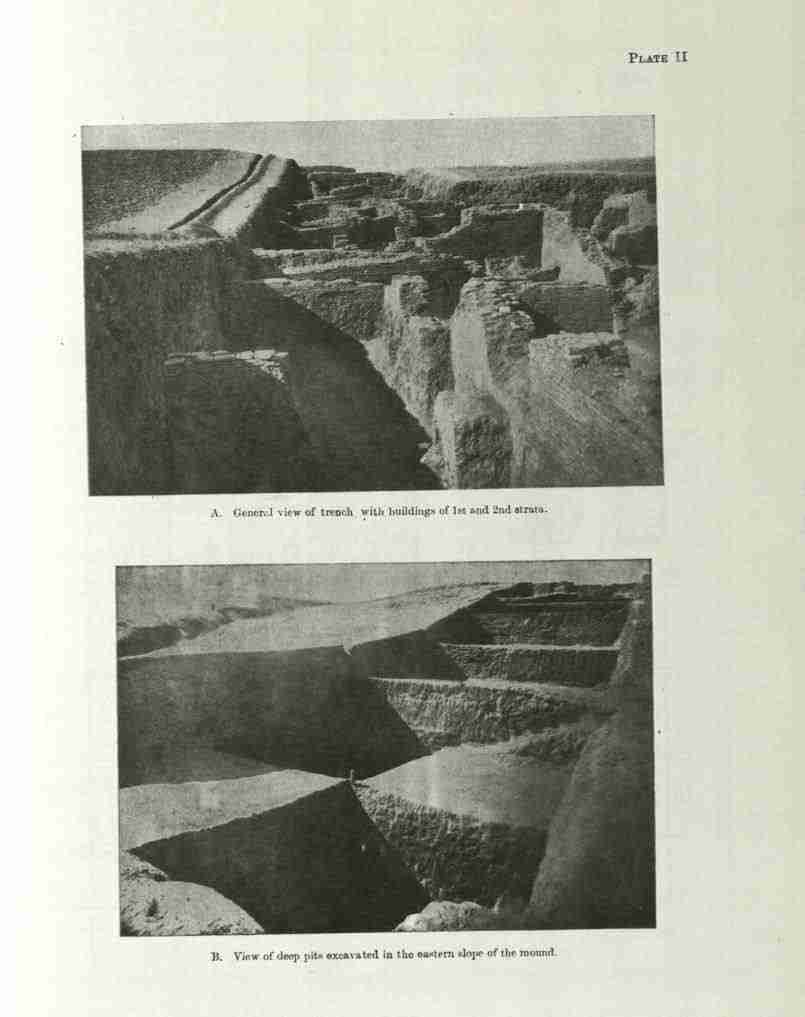
In 1938 and 1939, H.L. Srivastava — then Superintendent of the ASI's Frontier Circle, based in Lahore — opened a long trial trench across one of the southern mounds. The published report, Excavations at Agroha (originally ASI Memoir No. 61, 1952; reprint 1999), records what came out. The numbering of the report and the long delay in its publication are themselves an artefact of history: the manuscript was meant for the Annual Reports of the ASI, the field records went to the Frontier Circle office in Lahore, and after the 1947 Partition the records ended up on the wrong side of the border. Srivastava re-drew several plates from photographs of his original drawings to get the report into print at all.
What was in the trench
The Agroha trench exposed about 401 portable antiquities and the foundations of what Srivastava read as a "well-planned and prosperous settlement." The buildings were of burnt brick, mostly dwelling houses, distinct from each other but with their full extent never fully traced. Most of the rooms were paved on the south-western side. Doors had stone sills; from the heavy iron fittings — nails, flat bars, door-rings, clasps and clamps — Srivastava reconstructed them as wooden doors set into wooden frames.
The deposits in almost every room contained ash and signs of burning. Some rooms had been particularly affected — those in squares 7L/4 and 7L/5 yielded burnt birch-bark manuscript, an inscribed clay seal, a small gold bead, and charred grains. The picture is of a town that was repeatedly destroyed by fire over its active life. The historical sources mention this directly: the medieval chroniclers Ziau-d-Din Barani and Shams-i-Siraj Afif both record Agroha as a flourishing town that suffered considerable damage during the famine and reign of Muhammad Tughluq (1325–1351), and Ibn Battuta describes the demolition of its Hindu temples and the use of the salvaged material by Firuz Shah Tughluq for the construction of Hisar-i-Firuza in 1354. Some of the building stone in the Hisar Gujri Mahal, Firuz Shah's Mosque, and the Jahaz Kothi can be plausibly traced to the Agroha demolitions.
Among the recovered antiquities were:
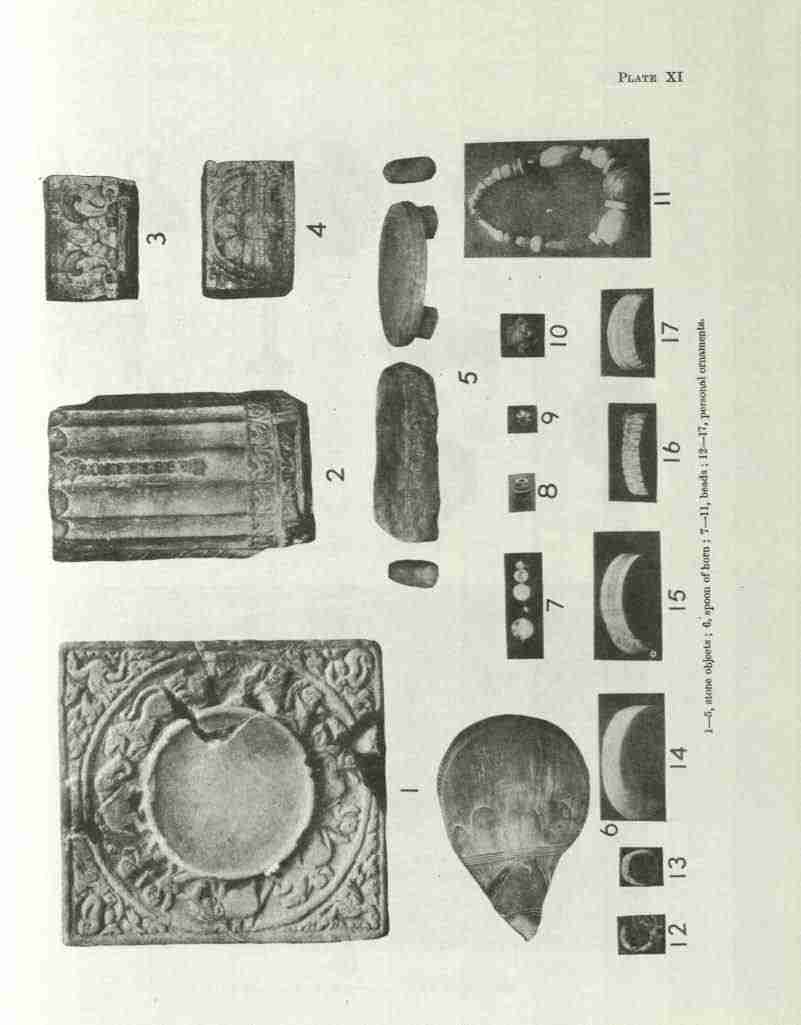
- A copper sword and a copper spoon, both well-preserved.
- A heap of iron objects, including hanging bells, dishes, lamps with handles, axes and sickles, and a wide range of nails, rings, and door-frame accessories.
- An inscribed terracotta tablet with a handle — measuring 7-7/8 by 1-3/8 inches — bearing the seven svaras (musical notes) of Indian classical music, written in the script of the 9th century CE: sa, ni, dha, pa, ma, ga, ri, sa — in reverse order, descending the scale.
- Burnt birch-bark manuscript fragments in a script that resembles the Bakhshali manuscript, palaeographically dated to the 9th century CE.
- A clay seal, unfortunately badly burnt, which N.P. Chakravarti tentatively read as bearing the legend Pavanesa — possibly an epithet of Rudra (the Vedic precursor to Shiva). The seal also bears a bull, the vahana (mount) of Shiva.
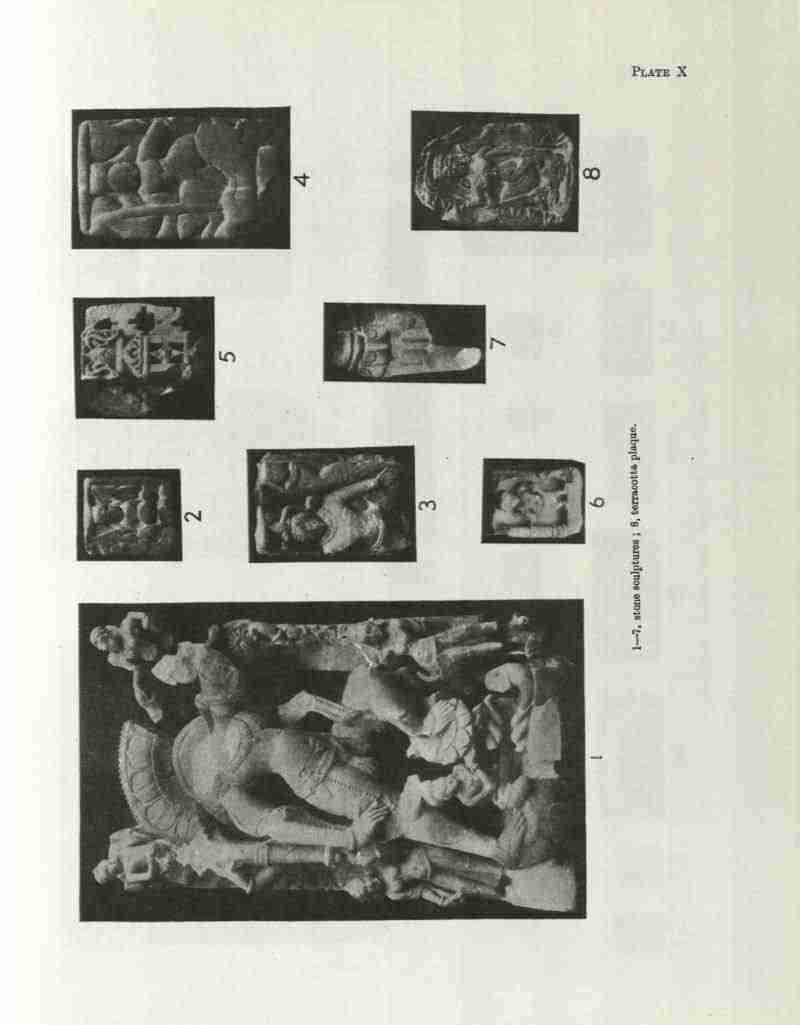
- Stone sculptures, all in fragments and showing fire damage. One, pieced together, represents a standing image on a lotus supported by Nagas (serpent deities). The plaque tradition identifiable on smaller fragments includes Mahishasuramardini and probably Kubera.
The coins
The most decisive find from the dig, in terms of dating the site, was numismatic.
Two pottery jars, buried in pits in adjacent excavation squares (7P/3 and 7P/7), each contained a coin hoard. The first jar held five silver coins: one each of the Indo-Greek kings Antialcidas, Apollodotus, Strato and Amyntas, plus one early Indian punch-marked coin with solar and tree symbols. The second jar held 51 mostly rectangular silver coins, all from the same local issue. Many of these bore the Brahmi inscription Agodaka Agacha Janapadasa — "of the janapada of Agacha [people of] Agrodaka."
The Agacha was a janapada — a tribal republic of the Mauryan-and-after period — whose territory probably included the Agroha mounds. Agrodaka, written on these coins, is the Sanskrit/Prakrit name of the town. The coins are stylistically dated to roughly the 2nd century BCE, which fixes the active phase of the city in the Indo-Greek period.
This is what the legend of Maharaja Agrasen does not. Local tradition, particularly within the Aggarwal community for whom Agroha is the ancestral homeland, holds that the city was founded by a king named Agrasen — sometimes dated, in popular telling, to many millennia before the present. The archaeology says the mature city was Agrodaka, that it was a working second-century-BCE town in the Indo-Greek orbit, and that it had been demolished in the 14th century CE for building material. There is no archaeological evidence for a much earlier founding. There is also nothing wrong with the community tradition having grown up around a real historical place — just as later traditions grew up around real Mauryan and Sunga sites. The two stories — legendary Agrasen and archaeological Agrodaka — sit alongside each other; they are not the same story, and conflating them does not help either.
What the report could not tell us
Srivastava is admirably direct about the limits of his work. The trench reached the Indo-Greek-era levels at about 12 feet and stopped. The two pits within those squares, deeper than the main trench, suggested an even earlier occupation level around 23-and-a-half feet below the surface, but the rest of the deeper deposit was never reached. Whatever Agroha was before the 2nd century BCE — Iron Age village? Painted Grey Ware site? — the 1938-39 dig couldn't say.
It also couldn't fully reconstruct the destruction sequence. The site has at least one major burning event, possibly more. Some rooms were burnt twice. The coin hoards in jars suggest people hiding their wealth in advance of trouble that they did not return to dig up. The objects from the burnt rooms — birch-bark manuscript, clay seal, gold bead — are the kinds of things hidden quickly. None of the contexts have been carbon-dated; the absolute chronology of the destructions rests on the late-medieval texts that mention Tughluq-period damage.
The report ends, modestly, with the observation that excavation on a larger scale at the site might yield important antiquities of an earlier period. It would. But the dig that would do that has not yet happened.
A real town, a long history
What Srivastava's small 1938-39 trench established is a date. Agroha was a real working town in the second century BCE, with a name (Agrodaka), a janapada affiliation (Agacha), and trading connections strong enough to bring Indo-Greek silver into a local hoard. It went through repeated destruction-and-rebuilding cycles. It survived into the medieval period as a flourishing town of the Tughluq frontier. And it ended in the 14th century, demolished for stone to build a new fortified capital.
That is a continuous and concrete history. It does not need the legendary 5,000-year framing to be interesting. It is interesting because it actually happened.